

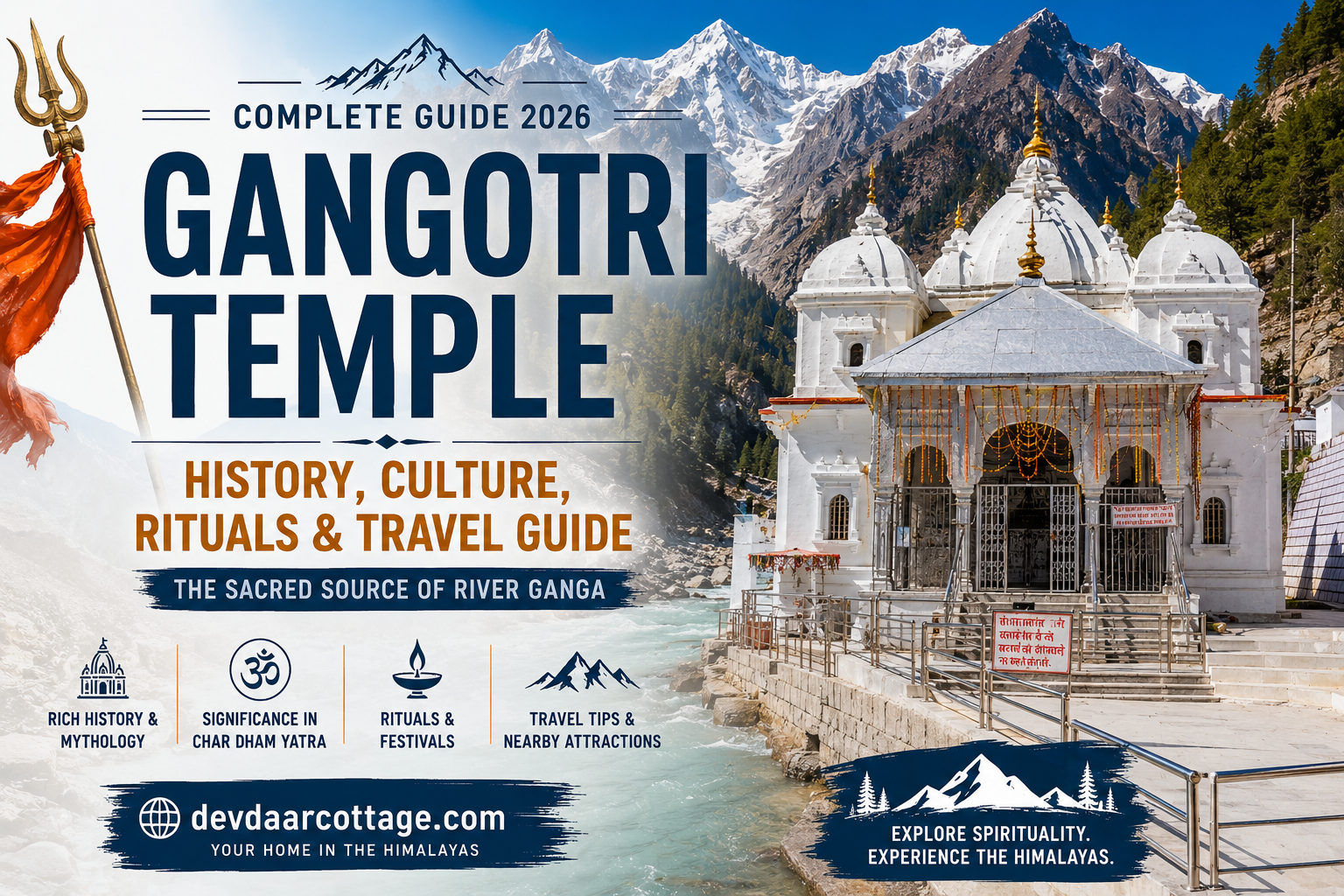
Nestled in the breathtaking Garhwal Himalayas at an altitude of 3,415 metres (11,204 ft) above sea level, the Gangotri Temple stands as one of the most revered and spiritually powerful shrines in all of India. Situated in the Uttarkashi district of Uttarakhand, this sacred temple is dedicated to Goddess Ganga — the divine mother of the holiest river in Hinduism, the Ganges.
The Gangotri Temple is not merely a place of worship; it is a living monument of faith, mythology, culture, and centuries-old tradition. Every year, hundreds of thousands of pilgrims trek through rugged mountain terrain to seek the blessings of Goddess Ganga at this hallowed site. Its towering white peaks, roaring glacial waters, and the haunting chants of Sanskrit prayers create an atmosphere unlike any other on Earth.
As one of the four sacred sites of the Char Dham Yatra — the holiest Hindu pilgrimage circuit — Gangotri Temple holds immense importance for Hindus worldwide. Whether you are a devout pilgrim, a culture enthusiast, or a curious traveller, understanding the history and culture of Gangotri Temple is an enriching and soul-stirring journey.
See our complete guide to Char Dham Yatra: The Ultimate Pilgrim’s Handbook for planning your full pilgrimage.
2. Gangotri Temple: Historical Background
Ancient Origins
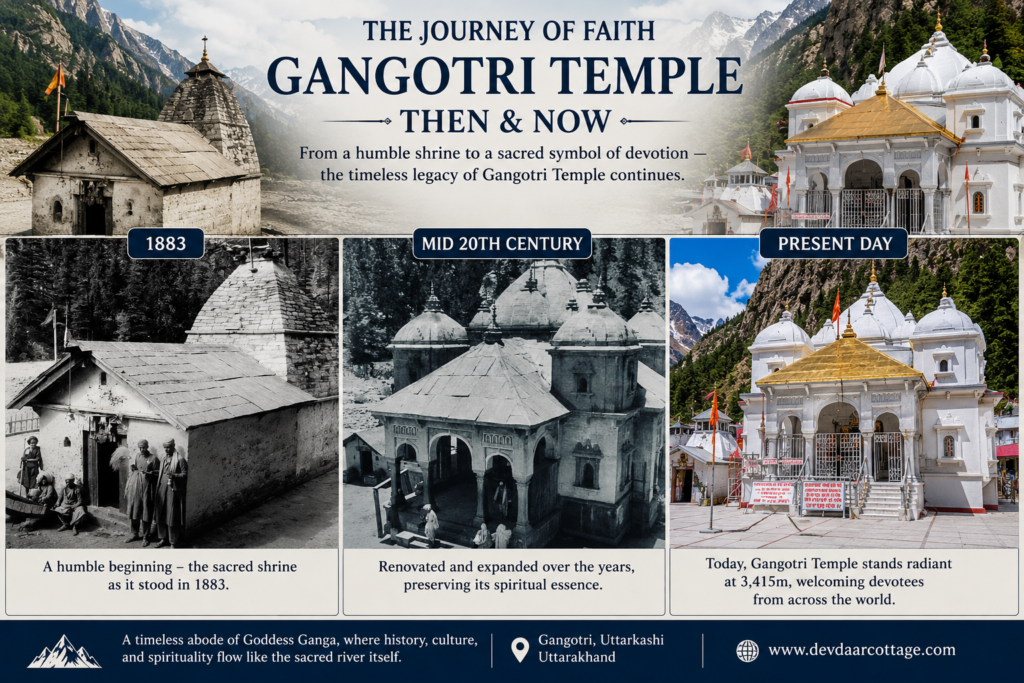
The origin of the Gangotri Temple traces back to the early 18th century, though the site itself has been considered sacred for thousands of years. The temple was constructed in the early 1700s by Amar Singh Thapa, a brave Gurkha commander, as an act of devotion and gratitude to Goddess Ganga.
However, the religious and spiritual importance of the Gangotri region is far older — references to the sacred Bhagirathi River (the original name of the Ganges at its source) appear in ancient Hindu scriptures including the Ramayana, the Mahabharata, and the Puranas.
The Gurkha Connection
Amar Singh Thapa, a commander in the Gorkha Army of Nepal, was instrumental in establishing formal religious structures at Gangotri during a period when Garhwal was under Gorkha dominance (circa 1803–1815). He is credited with building the original temple structure at the sacred spot where King Bhagirath is said to have meditated for centuries to bring the Goddess Ganga down to Earth.
Renovation by the Jaipur Royal Family
The present-day Gangotri Temple structure visible to pilgrims was renovated and rebuilt by the Maharaja of Jaipur in the 20th century, giving it the elegant white granite appearance it bears today. The temple has undergone several restorations over the centuries, maintaining its architectural sanctity while keeping the spiritual essence intact.
Historical Timeline
| Period | Significant Event |
|---|---|
| Ancient (pre-history) | Site revered in Vedic scriptures as source of sacred Bhagirathi |
| ~700 CE | Adi Shankaracharya visits and establishes religious order |
| Early 1700s | Temple built by Amar Singh Thapa (Gurkha commander) |
| 1803–1815 | Gorkha occupation of Garhwal; temple maintained |
| 20th Century | Temple renovated by Jaipur royal patronage |
| 1986 | Gangotri declared part of the Gangotri National Park buffer zone |
| Present | One of four Char Dham sites; UNESCO consideration for World Heritage |
Learn more about the Gorkha Empire’s influence on Uttarakhand at Wikipedia: Gorkha Kingdom
3. Mythological Significance of Gangotri
The Legend of King Bhagirath
The most celebrated legend associated with the Gangotri Temple is that of King Bhagirath, an ancestor of Lord Rama. According to Hindu scripture, King Sagara — Bhagirath’s ancestor — performed a great Ashwamedha Yajna (horse sacrifice). The horse was stolen by the sage Kapila, who, when disturbed by Sagara’s 60,000 sons, cursed them and reduced them to ashes.
To liberate the souls of his ancestors, King Bhagirath performed rigorous penance for thousands of years, imploring Goddess Ganga to descend to Earth. Lord Brahma, pleased by his devotion, agreed to release Ganga from the heavens — but the force of her descent would have shattered the Earth. It was then that Lord Shiva agreed to receive Ganga in his matted locks, softening her fall before she flowed gently to the plains.
A natural rock formation near the Gangotri Temple, known as Bhagirath Shila, is the sacred stone upon which King Bhagirath is believed to have meditated. Pilgrims reverently touch and worship this stone as part of their visit to the Gangotri Temple.
Goddess Ganga: The Divine River
Goddess Ganga is revered in Hinduism as the embodiment of purity, liberation, and divine grace. It is believed that bathing in the sacred waters of the Ganges — or even merely thinking of her — can wash away sins accumulated over multiple lifetimes. The spiritual power of Ganga is described vividly in the Skanda Purana, Agni Purana, and Padma Purana.
At Gangotri, the Bhagirathi River (Ganga at its source) is considered at its most pure and most powerful. The water here is glacially cold, crystal clear, and carries the unique property of self-purification — scientifically attributed to its high bacteriophage content and mineral composition from the Gangotri Glacier.
Lord Shiva’s Role at Gangotri
The Gangotri Temple region is also closely associated with Lord Shiva, as it was here that he received Ganga in his matted locks. The nearby town of Harsil and the mountain backdrop of the region are considered Shiva’s sacred domain. A Shivling (a natural ice formation) has been found near the Gangotri Glacier, reinforcing the area’s Shaivite connections.
Read our article on The Story of Goddess Ganga: From Heaven to Earth to explore the full mythological narrative.
4. Architecture of Gangotri Temple
Design & Structure
The Gangotri Temple is a stunning example of North Indian (Nagara style) Himalayan temple architecture. The temple is constructed in white granite, giving it a pristine, ethereal appearance that harmonises beautifully with the snow-covered peaks surrounding it.
Key architectural features include:
- Shikhara (Spire): A prominent, tapering tower rising above the main sanctum, typical of North Indian temple design
- Garbhagriha (Sanctum Sanctorum): Houses the silver idol of Goddess Ganga, adorned with flowers, silks, and gold ornaments
- Mandapa (Prayer Hall): An open hall where devotees gather for prayers, bhajans, and rituals
- Bhagirath Shila: The sacred stone slab adjacent to the temple where King Bhagirath meditated
- Ghats: Stone steps descending to the Bhagirathi River for ritual bathing
The Idol of Goddess Ganga
The primary deity enshrined in the Gangotri Temple is Goddess Ganga, represented as a beautiful goddess standing on a Makara (crocodile) — her sacred vehicle. The idol is richly decorated, especially during festivals, with gold ornaments, silk garments, and seasonal flowers like marigold and lotus.
Surrounding Environment as Architecture
The temple’s setting itself is an architectural marvel of nature — framed by soaring Himalayan peaks, the thundering Bhagirathi gorge, ancient deodar forests, and glacial air. Many spiritual scholars consider the natural amphitheatre around the Gangotri Temple to be as sacred as the temple itself.
5. Religious & Cultural Importance
Centre of Himalayan Spirituality
The Gangotri Temple is much more than a religious site — it is the cultural heartbeat of the Garhwal Himalayan region. For millennia, this area has attracted sages, saints, philosophers, yogis, and seekers of truth. The region around Gangotri is considered part of Devbhumi (“Land of Gods”), a term used for Uttarakhand itself.
Cultural Practices at Gangotri
Local culture around Gangotri Temple is deeply intertwined with Garhwali traditions:
- Garhwali Folk Music: Devotional songs called Jagar and Mangal are sung during festivals and puja ceremonies
- Traditional Attire: Priests wear traditional saffron or white dhoti-kurta; local women dress in ghagra-choli with silver jewellery
- Seasonal Rhythm of Life: The opening and closing of the temple (Akshaya Tritiya and Diwali) mark the beginning and end of the mountain community’s active season
- Pilgrimage Economy: The temple sustains the livelihoods of thousands of local families — priests (pandas), shop owners, porters (kanchhas), and hotel operators
The Priests of Gangotri Temple
The temple is managed by Semwal Brahmins, a priestly community who have served Goddess Ganga at Gangotri for generations. The head priest (Mukhya Pujari) performs daily rituals with strict Vedic protocols. During the winter months when the temple is closed, the deity is ceremonially relocated to Mukhba village — Goddess Ganga’s winter abode — where worship continues uninterrupted.
For deeper reading on Garhwali culture, visit the Garhwal Mandal Vikas Nigam website
6. Gangotri as Part of Char Dham Yatra
The Gangotri Temple is one of the Chota Char Dham — four sacred pilgrimage sites in Uttarakhand that every devout Hindu aspires to visit. The four dhams are:
| Dham | Deity | Location |
|---|---|---|
| Yamunotri | Goddess Yamuna | Uttarkashi District |
| Gangotri Temple | Goddess Ganga | Uttarkashi District |
| Kedarnath | Lord Shiva | Rudraprayag District |
| Badrinath | Lord Vishnu | Chamoli District |
The traditional Char Dham Yatra route follows this sequence, and Gangotri is typically the second stop after Yamunotri. The pilgrimage is considered one of the most spiritually rewarding journeys in Hinduism, offering devotees the opportunity to seek blessings from the principal divine forces — Shakti (Ganga/Yamuna), Shiva (Kedarnath), and Vishnu (Badrinath).
Completing the Char Dham Yatra is believed to wash away the sins of a lifetime and grant moksha (spiritual liberation).
Plan your journey with our Char Dham Yatra Complete Itinerary: 10 Days Guide.
7. Rituals & Festivals at Gangotri Temple
Daily Rituals
The Gangotri Temple follows a strict daily ritual schedule managed by the Semwal priestly community:
| Time | Ritual |
|---|---|
| 6:00 AM | Pratah Puja (Morning Prayers) |
| 8:00 AM | Abhishek (Sacred bathing of the deity) |
| 12:00 PM | Bhog (Food offering) |
| 6:00 PM | Sandhya Aarti (Evening prayer with lamps) |
| 9:00 PM | Shayan Puja (Night prayer, temple closed) |
The Ganga Aarti performed at dusk is a highlight for all pilgrims — the sight of lit diyas (earthen lamps) reflected in the silvery Bhagirathi waters against the backdrop of mountain peaks is profoundly moving.
Major Festivals
1. Akshaya Tritiya (Temple Opening) The Gangotri Temple opens every year on Akshaya Tritiya (April–May), marking the arrival of the pilgrimage season. This is one of the most auspicious days in the Hindu calendar, and the opening ceremony draws thousands of devotees.
2. Gangotri Jayanti Celebrated on the 10th day of the waxing moon in Jyeshtha month (June), this festival marks the descent of Goddess Ganga from the heavens. Grand prayers, processions, and cultural programmes are organised.
3. Ganga Dussehra One of the most important festivals at Gangotri Temple, Ganga Dussehra is celebrated with enormous devotion. Devotees take a holy dip in the Bhagirathi River believing it will cleanse them of ten (dasha) major sins.
4. Diwali (Temple Closing) On Diwali (October–November), the Gangotri Temple closes for winter. The deity is ceremonially carried in a palanquin to Mukhba village amid chanting, music, and a large congregation of devotees. The procession itself is a deeply moving cultural spectacle.
8. Best Time to Visit Gangotri Temple
| Season | Months | Conditions | Recommended? |
|---|---|---|---|
| Summer (Best) | May–June | Pleasant 10–20°C, temple open, good trekking | ✅ Highly Recommended |
| Monsoon | July–August | Heavy rain, landslide risk, roads blocked | ⚠️ Exercise Caution |
| Post-Monsoon | September–October | Clear skies, snowcapped peaks, excellent views | ✅ Recommended |
| Winter | November–April | Temple CLOSED, heavy snowfall, roads shut | ❌ Not Accessible |
Peak Season: May–June and September–October are ideal for visiting Gangotri Temple. The weather is clear, roads are open, and the natural beauty is at its most spectacular.
9. How to Reach Gangotri Temple
By Air
The nearest airport is Jolly Grant Airport, Dehradun (~250 km from Gangotri). From Dehradun, take a taxi or bus to Uttarkashi and then to Gangotri.
By Train
The nearest railway station is Rishikesh Railway Station (~250 km). From Rishikesh, buses and taxis are available to Uttarkashi and Gangotri via the scenic mountain road.
By Road
Gangotri is well-connected by road:
- Delhi → Rishikesh → Uttarkashi → Gangotri: ~500 km (approx. 14–16 hours)
- Dehradun → Uttarkashi → Gangotri: ~250 km (approx. 8 hours)
- GMOU/ISBT buses run regular services from Delhi, Dehradun, and Rishikesh to Gangotri during the pilgrimage season.
Check road conditions and bus schedules at Uttarakhand State Transport Corporation (UTC)
10. Nearby Attractions
| Attraction | Distance from Gangotri | Significance |
|---|---|---|
| Gangotri Glacier (Gaumukh) | 18 km trek | Source of the Bhagirathi / Ganges |
| Tapovan Meadow | 24 km | High-altitude meadow near Mt. Shivling |
| Kedartal Lake | 18 km trek | High-altitude glacial lake |
| Harsil Valley | 25 km | Apple orchards, stunning valley |
| Mukhba Village | 24 km | Winter abode of Goddess Ganga |
| Uttarkashi Town | 100 km | Nehru Institute of Mountaineering, Vishwanath Temple |
| Dayara Bugyal | 110 km | Beautiful alpine meadow, trekking paradise |
Read our Gaumukh Tapovan Trek: Complete Guide for Beginners for the most iconic trek from Gangotri.
11. Travel Tips & Pilgrim Guide
Essential Tips for Visiting Gangotri Temple
✅ Register for Char Dham Yatra — Online biometric registration is mandatory. Register at uttarakhandtourism.gov.in before departure.
✅ Dress Modestly — Wear traditional or modest attire. Remove shoes before entering the temple. Leather items are not permitted inside the temple complex.
✅ Health Precautions — Due to high altitude, acclimatise properly. Carry altitude sickness medication (Diamox), warm layers, and a first-aid kit.
✅ Water — Gangotri’s Bhagirathi water is considered sacred and safe to drink directly at source. Carry a reusable water bottle.
✅ Photography — Photography is allowed in the temple complex but must be done respectfully. No photography inside the inner sanctum (garbhagriha).
✅ Carry Cash — ATMs are limited and often out of service in remote areas. Carry sufficient cash from Uttarkashi.
✅ Eco-consciousness — Gangotri falls within a protected National Park buffer zone. Carry your waste out. Single-use plastic is banned.
✅ Book Accommodation Early — GMVN (Garhwal Mandal Vikas Nigam) Tourist Bungalow, dharamshalas, and private guesthouses fill up fast in peak season.
Book GMVN accommodations at the official site: gmvnl.com
12. FAQs About Gangotri Temple
The Gangotri Temple is famous as the sacred source of the River Ganges and one of the four Char Dham pilgrimage sites in Uttarakhand. It is dedicated to Goddess Ganga and holds immense religious significance in Hinduism.
The Gangotri Temple opens on Akshaya Tritiya (April–May) and closes on Diwali (October–November) every year due to heavy snowfall in winter.
No. Gangotri Temple is located in the town of Gangotri. Gaumukh (the actual glacier snout and source of the Bhagirathi River) is an 18 km trek beyond the temple.
The original Gangotri Temple was built in the early 18th century by Amar Singh Thapa, a Gurkha commander. The current structure was renovated by the Maharaja of Jaipur.
All rituals at Gangotri Temple are conducted in Sanskrit, India’s ancient sacred language. Local prayers and folk songs are in Garhwali.
Yes, Gangotri is generally safe for pilgrims and trekkers. However, during monsoon season (July–August), landslides can make the roads treacherous. Always check weather and road conditions before travelling.
A standard pilgrimage visit to Gangotri Temple takes 1–2 days. If you plan to trek to Gaumukh, allow an additional 2–3 days.
13. Conclusion
The Gangotri Temple is far more than a place of worship — it is a confluence of history, mythology, culture, ecology, and spiritual energy that has shaped Hindu civilisation for millennia. From the legendary penance of King Bhagirath to the living traditions of Semwal priests, from the thundering glacial waters of the Bhagirathi to the serene snow-capped peaks, every element of Gangotri speaks of the divine.
Whether you come to offer prayers, seek peace, or simply witness the staggering grandeur of the Himalayas, visiting the Gangotri Temple is an experience that leaves a permanent imprint on the soul. It is a reminder that in this fast-paced modern world, there exist places where time slows, the heart stills, and the eternal whispers through the mountain air.
Plan your visit to Gangotri Temple today — and take the first step on a journey that pilgrims have taken for thousands of years.